Safety first
Stay out of standing water near outlets, cords or the electric panel. If you smell gas, leave the building and call 911 or your gas utility from a safe place.
1. Where to look
Ready.gov says the valve you want is on the main water line where it enters your house. Possible locations include where the supply enters the home, a utility area, or near the water heater. Layouts vary. Many homes get water from a meter near the street, so the side of the house facing it is a good place to start. Check these spots:
- The crawlspace, if your home has one. Look where the water line comes in through the foundation. Greenville Water lists the crawlspace as a place the shut-off valve may be.
- A closet or utility area near the front of the house. Greenville Water lists this spot too.
- Near the water heater, or where the water line enters the home. WSSC Water, a public utility in Maryland, lists these spots as well. A valve right beside the water heater may shut off only that appliance.
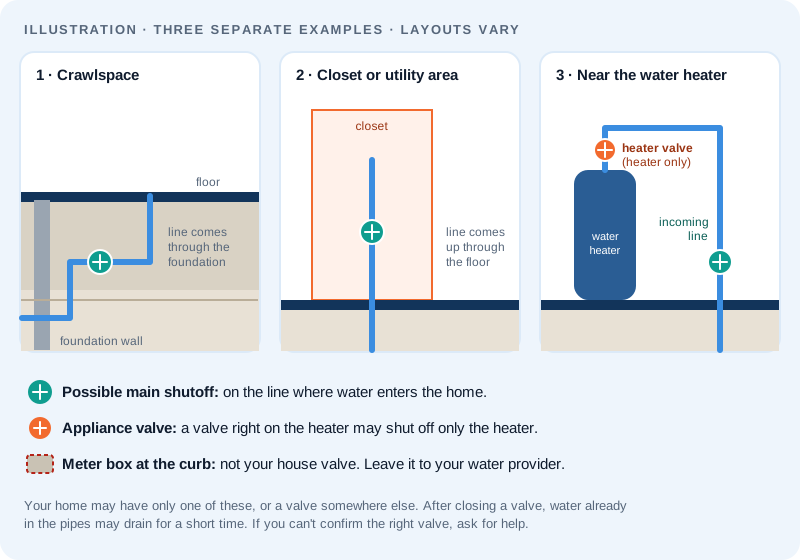
Is it the main valve or the heater's valve? A valve on the pipe at the top of the water heater may shut off only the heater. Water already in the pipes may continue to drain after shutoff. If flow continues and you can't confirm the correct valve, stop and ask your water provider or a qualified plumber for help. Don't force a valve.
2. The box at the curb isn't your valve
The box near the street holds the water meter. Ready.gov notes that the street valve in that box isn't the house valve: it's extremely difficult to turn and needs a special tool. Greenville Water counts meter boxes among its own water facilities. Leave the meter box to your water utility.
3. How to close it
- Round wheel handle: turn it clockwise until it stops. WSSC Water says it may take two or more full turns.
- Lever handle: turn it slowly a quarter turn, until the lever sits across the pipe instead of along it.
- Check that it worked: open a faucet on the highest floor to relieve pressure and watch the flow. Some water already in the pipes may drain out before it stops.
- If it won't move, stop rather than forcing it, and call a licensed plumber.
Fire sprinkler system?
If your home has a fire sprinkler system, don't guess which valve controls it. For a normal plumbing leak, avoid shutting off fire protection; get help if you can't identify the shutoff for your household water.
This guide is for finding and identifying the shutoff. It doesn't cover draining the plumbing system or servicing a water heater or boiler.
4. Tag it and test it now
Ready.gov recommends tagging the valve so it's easy to find, making sure everyone in your household knows where it is, and checking that it shuts off completely. A valve can be rusted open or fail to close all the way; if so, Ready.gov says to replace it. Greenville Water also asks customers to know and mark where their emergency shut-off valve is.
For replacing a main valve, we recommend a licensed plumber. Before work starts, check the plumber's license and ask whether a permit is needed (who issues plumbing permits).
5. If you can't find it, or it won't close
- Water is spreading inside: call a licensed plumber. Keep people away from wet areas near electricity.
- A leak in the yard, at the meter box, or water you can't stop: contact your water utility. Greenville Water and Spartanburg Water list after-hours lines for emergencies on their websites. Other Upstate providers include Greer CPW, Easley Combined Utilities, the City of Anderson and the City of Pickens. Your water bill shows which provider serves your home; ask them how they handle emergencies.
6. How our referral line will work
When it opens, a short automated prompt will ask for your ZIP code. If an independent provider who serves your ZIP is available, the call will be connected. Availability isn't guaranteed, especially after hours.
We won't charge you for the referral; your phone carrier's usual rates will apply. The provider quotes the job. Not sure what to say? Get call-ready in three taps.
More Upstate guides
- Water heater leaking? What to do first
- Frozen or burst pipe? What to do first
- No hot water? What to check first
- Clogged drain? What to try first and when to call
- Who issues plumbing permits in the Upstate?
- How to check a plumber's license in SC
- No heat? First checks for a furnace or heat pump
- Carbon monoxide alarm going off? What to do
Sources
- Ready.gov (FEMA), Safety Skills (checked October 24, 2026)
- Greenville Water, In Case of Emergency (checked October 24, 2026)
- Spartanburg Water, Emergencies (checked October 24, 2026)
- WSSC Water, Find and Operate Your Main Water Valve (checked October 24, 2026)
- Greer CPW, Water; Easley Combined Utilities, Customer Service; City of Anderson, Water Department; City of Pickens, Utilities (checked October 24, 2026)
- Piedmont Natural Gas, Natural Gas Safety (checked October 22, 2026)